Biting Off More Than I Can Chew

Mark Paxson

When I started my writing journey around 20 years ago, I came up with what I believe was a simple idea for my first novel. Since then, my ideas have become more and more complex. It’s one of the reasons I have struggled with writer’s block — the idea that I cannot see these more complicated stories to completion.

I have a half dozen half-completed novels that I struggle mightily with when I dip my toe back in every now and then.

And so it is today. I’m about to publish a novella and a short story collection. And with those nearing fruition, I started turning towards something else while I wait for that process to wind down.

A couple of days ago, I started reading a story I started in 2015. One that could be, should be, a novel. As I’m reading it, I love what I’ve done with the first 7 or 8 chapters, which span almost 20,000 words. I’m concerned though that maybe there are too many darlings in the story. Ultimately, however, my biggest concern is that I have bitten off more than I can chew with this effort. In two different ways.

First, can I write the path these characters are taking and get to the ending. I think I can do that. It’s the second issue that is problematic.

I start stories with a certain flow, a certain vibe, and then I become convincned that I can’t carry that flow or vibe through to the end. There are things I’m doing with this story that … well … it’s a dystopian story where I can kind of make up the rules as I go. It’s led to some fun stuff, a certain amount of freedom in the telling, but once started, I feel like that fun and freedom and rule-making needs to carry through each chapter. And it’s a hard thing to do.

I’m torn between cutting to the ending, which will leave it as a novella and with a whole lot of holes in the possible story, or gritting my teeth and grinding through a longer version of the tale. Something that has baffled me so far whenever I try to sit down with this story. Which way do I go? I want to tell the full tale, to not skip ahead to the ending. I want to fill those holes up with the kind of vibe I started the story with. But I don’t know if I can do it and, eventually, doing so might lead to this being an epic tale of many, many words. Requiring much more patience and effort than I may be willing to give.

Do you ever have this experience? You start a story. It’s going great and then something gets in the way and you begin to wonder if you can actually pull it off. If you can get your head around all of the details and the possibilities and the realities of the story itself?

If you do … what do you do about it? I’d love to hear your thoughts because I have to figure out how to finish this tale that I really, really like and do it right.

Speaking At A Conference

There is a slim chance I might speak at a local writing event in November. Slim because I’m terrified of public speaking. But a chance because I am committed to overcoming my fears.

I have an idea for what I would want to talk about, but I’m curious. If you had to fill an hour, including time for questions, and could talk about anything related to writing, what would you want to talk about?

Is It Vanity?

— Mark Paxson

I’m reading a book recently published by F.L. Rose, one of my favorite indie writers. The book is called The Point of Us. I’m waiting to complete it before I reach any conclusions about the quality of the story, but I’m pretty certain it’s gonna be a good one. I’m gonna skip the description of what the story is and go right to my question for this post.

One of the main characters in the story is a writer, a pretty successful novelist. At some point, there is a discussion of writers and why they do what they do and the conclusion is … that it is all about vanity.

So … that’s my question. Do we do this for vanity? Do we slave over our stories and put them out into the world for vanity’s sake?

I’m of mixed minds on this. On the one hand, I write strictly for my own internal reasons. I don’t believe it has anything to do with vanity. I write because I want to see if I can do it. Turn an idea that forms in my head into a story with a beginning, middle and end, and is … readable. I don’t know. I write because I want to and I want to see that idea through to the final words.

But then … when I post it on my blog or publish something via the Amazon monolith, why am I doing that? The story hasn’t been blessed by the gatekeepers. No agent picked it up. No publisher. I am swimming free and clear of the gatekeepers and still putting my words out there into the wide, wide world … and why am I doing that?

Why do you do it?

In our last video chat we began a conversation about why we read. Maybe a better question for us indie authors is why do we publish?

Years ago, before technology turned the publishing world upside down, there were vanity publishers. Places a writer could go to pay thousands of dollars to have their book “published,” which typically meant getting boxes and boxes of copies of their books that the authors than had to try to figure out how to sell themselves.

Now, vanity publishers have been replaced with KDP and Ingram Spark and SmashWords and countless other platforms that allow us to publish our books with almost no cost up front. (And there are still companies like the old-fashioned vanity publishers — places that promise to publish your book for a small fee of several thousands of dollars and then leave you hanging with no support, no marketing, no nothing.)

The question remains though, regardless of how easy it has become to publish, why do we do it?

For me, I want to reach readers and hope to grow my audience and get more people reading my stories. But why? What does that mean to me if they do? Why should it matter? Particularly in the modern world of indie publishing, where there are so many books getting published it’s virtually impossible to be seen and to be read by anybody other than those who already know you.

I think there’s some truth to F.L. Rose’s thoughts as expressed in The Point of Us. There is some vanity involved. The first definition of “vanity” is “excessive pride in or admiration of one’s own appearance or achievements.”

When I read that definition, I begin to reconsider the idea that I publish for vanity. I’m far from “excessive pride in or admiration” of my writing. But I typically do like the end result. My biggest reason for publishing and sharing my stories is to … just put them out there and see if readers like what I’ve come up with. But still, there is a feeling of confirmation when I get a positive review, there is still a good feeling in the cockles of my heart when somebody has something good to say about something I’ve written. If I were to publish and none of those good things were ever said or shared with me … if I just published into a void without reaction or response … I most likely would stop publishing. And if I stopped publishing, I’d stop writing. Because at the end of the day, I write to share and to get a reaction.

Is that vanity?

Is that why we write and why we publish?

Why?

Mark Paxson

A sneak peek into our next video chat, which will be recorded this coming weekend …

One of the topics we’re going to discuss is “why do we read,” which I saw somebody ask on Twitter several months ago. Hell, it’s one of those questions I see people in the Twitter community ask at least once a week over on Twitter. But I thought it was an interesting question so I added it to our list for our conversations about writing.

Why?

Because, well, I guess if we don’t know why people read, how do we know what to write? And maybe even as important a question that grows out of that opening question of why we read is … why do we write?

So … in advance of our weekend chat, is there anybody out there who wants to share in the comments why they read? And for the writers out there, does that play at all into why or what they write?

Choosing Your POV

Mark Paxson

I finished writing something and have pondered what to move on to next. This month started with me committed to writing a sequel to the novel I published almost a year ago. That particular story is told in first person from the perspective of several different characters.

The story I just completed is told in first person from one character’s perspective. About half way through, I decided to change it to third person and get some other character’s in the mix, to broaden the story a bit. But then I decided to keep in in first person because I wanted the story to be that character’s story and only hers. As a result, it makes for a much more minimalist of a story. We’ll see what people think.

Now I’m moving on to what’s next. I’ve decided to shelve the sequel above for another project. This morning I spent some time at a local books and music festival. I talked with a woman who has spent her life gathering historical tidbits of her ancestors and has spent the last five years putting those bits into stories. Kathy Lynne Marshall has written a handful of books in those five years. She includes information and resources about how to gather historical information about people from the past. So … I’m reading The Mystery of Margaret Booker now. About her great-great-great-great-great grandmother. Born a slave who walked to freedom 30 years later.

And an interesting thing happened when I got to the first page of the story. She tells it in first person. She is allowing Margaret to tell her own story in her voice.

That conversation and seeing the first person approach caused me to shift gears away from the sequel. I’m moving on to something that has been an objective for the last 4-5 years. A story about my grandmother, which I may have mentioned here a post or two ago. When I tried to launch the story back then, it was in third person. Which just seemed natural to me. How can I tell a story in first person from Grandma’s perspective? I can. Or at least I’m going to try.

More and more, it seems my stories are told in first person. My first novel wasn’t. Many of my short stories aren’t either. Most are told in third person, I believe. But lately, it seems like first person is the way to go. There is something about first person that I like. It’s easier to adopt a particular type of voice in first person. It’s easier to get inside a character’s head and see what they’re thinking and how they’re feeling.

But I wonder if that’s a good thing. Choosing a point of view or perspective because it makes the writing easier doesn’t necessarily make for a better story. Go back to that piece I just finishedd. I have no doubt that if I switched to third person and told the story from the perspective from multiple characters, the story would be more complex, with more layers. It’s what happened with my first novel — originally written in first person, but completely re-written in third person to allow for more details and more characters to have a place in the story. It definitely was a better story because of that change.

Occasionally, people ask how I decide POV for a story. I believe we’ve discussed it on video chats. My answer will always be … it depends. I still believe that, but I wonder what other writers think. How do you decide on the POV, or POVs, in which you’re going to tell a story? How do you decide between first person and third person? Is it a decision you can even describe? Because for me … it not only depends, it just kind of happens.

How Do You …

Mark Paxson

… write creative non-fiction?

Anybody out there do this? I’d love your thoughts on how you approach stories that are based on real life and real people.

I write mostly fiction. Almost entirely fiction. I’ve written a few short pieces that were “grabbed from the headlines” so they have a basis in reality, but were at the end of the day fictional.

One morning, I got to work to learn that the body of a man had been discovered to the east of our building. I went home that night and wrote his obituary, without knowing a thing about him. Around the same time, I also wrote a short story about a man trying to survive in Aleppo, Syria, as his country was torn apart by civil war. Completely fictional, but I’d like to think there were some elements of truth in what I wrote.

I currently have a barely started short story that is similar to Aleppo in that is based on one man’s efforts to survive in Ukraine as his country is torn apart by a foreign invader. I haven’t got that far because I want to make sure it is different than Aleppo and I’m still pondering that.

That’s about it, I think. I blog a lot about things going on in my life, but they aren’t really “stories.” But … I have a couple of real-life-based stories I want to write and I struggle with the “how” of writing a real-life story.

The biggest one, the most important one, is a story I want to write about my maternal grandmother. I have an opening scene that is based on a lot of facts I remember about her, facts I’ve uncovered on-line (like the manifest for the ship she came to America on when she was 18), and things my mom has told me. But once I get past that scene, I have no idea how to approach the rest of the story.

One more example. I had an assistant in my day job for more than ten years. She lived a fascinating life in her younger years — involving guns and gangs and casinos and well, all sorts of stuff. She kept insisting that I should write her story. To which I kept responding, “I have no idea how to write a real story.”

Part of the problem is that I’m a pantser, not a plotter. Creative non-fiction, or a true biography, likely requires more plotting than pantsing. If it’s based on real-life events, the story is right there before you. As a pantser, that’s just not how I write and typically, when I have figured out the “rest of the story” is when my block settles in.

Another problem, particularly with my grandmother’s story is that there is a lot I don’t know. A lot. As a result, I’d have to make up quite a bit about her life and that scares me. I want it to be as true to her and who she was as it can be, but how can I be sure of that if I have to make up so much of it.

I know that the solution to this, at least with respect to my grandmother’s story, is to use the facts that I have where I can and then be comfortable with fictionalizing the rest, while trying to be as true as I can to her. But … I haven’t figured out how to get over that hump yet.

My question for you then, if there are any CNF, memoir, or biography writers out there, is how do you approach writing a story that is real-life, based on real-life, or loosely reality-based. I know there are classes and programs out there that promise to teach a person how to do this, but I’m not much of a classroom-learner. I just need some ideas, some methods, some concept of how to approach this and then I can go from there.

A Writing Exercise

Mark Paxson

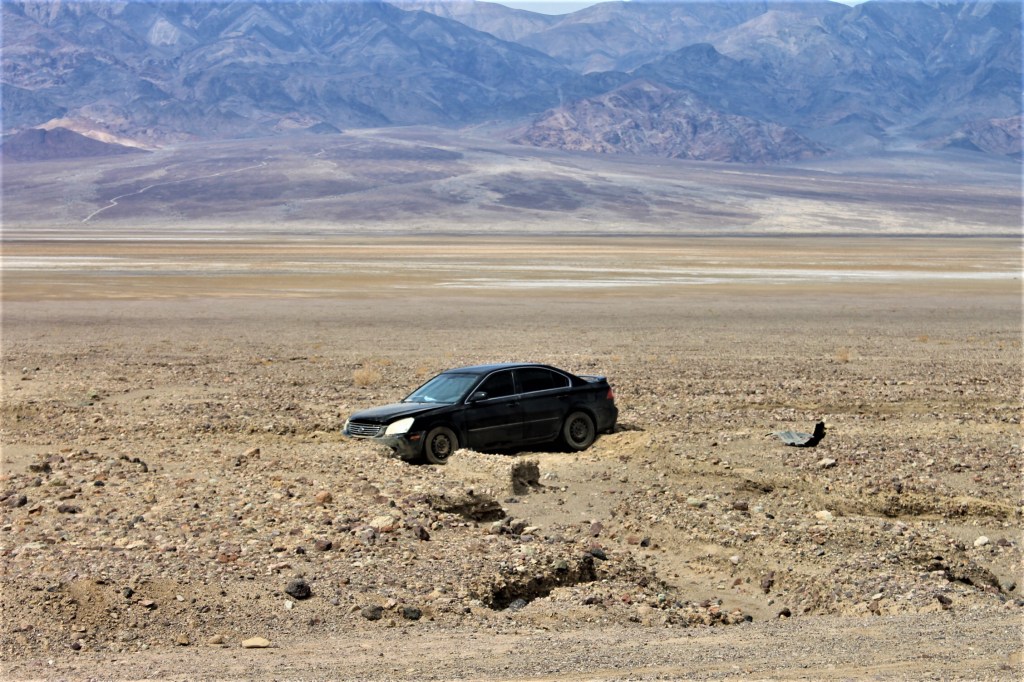
I just spent four days in Death Valley — one of the most desolate, isolated places in the continental United States. I take my camera on trips like this and take a lot of pictures of things.

Twice I stopped for pictures that had my wife questioning me. Both times I said the same thing. There’s a story there.

So, here’s your chance. Provide the story.

The first picture is of a car abandoned about 75-100 feet off the road in a place where I have absolutely no idea how it got there. I don’t recall seeing any tire tracks and the surface is pitted and bumpy enough I’m not sure how it could have got there. This is on the road from Furnace Creek to Badwater (the lowest piece of dry land on earth).

The second picture is of an old mine. I think it was probably a borax mine at one point. But I don’t think it’s operational anymore. You see things like this in places like Death Valley. Just random, in the middle-of-nowhere, factories or homes or buildings of one sort or other, that once thrived but now seem to be more ghost-like than real.

So … if you feel up to it and one of these (or both together) inspire a spark, write it and share it here. Put a link to it in comments if you post it to a blog, or email it to me and I’ll share it here. (mpaxson55@gmail.com)

In the meantime … hope you’re all writing. I’ve got more pictures to sort through.

Video Chat: We Begin to Answer Your Questions

Mark Paxson

Below is the video for our latest video chat, in which we begin to respond to the questions/suggested topics from our post at the beginning of the year. Thank you to those who offered suggestions. We really appreciate it.

The last question we address in this chat is a question related to the “rules” of marketing. I wanted to take a moment to provide a fuller answer than I did in the chat.

As I say in the video, I’m not sure what the “rules” of marketing are for writers. So, I struggle with that from the outset, but as I think about it more, I can come up with a few.

Establish a social media presence. I know of a writer who got a publishing contract with a small publisher. They published two of his books — cozy mysteries. But then passed on anything else from him because he didn’t have a sufficient social media presence for them.

This need for a social media presence is something that has been in the background ever since I started my publishing journey. You gotta have a blog! So, I got a blog. And then you have to have Twitter and Facebook and Instagram. And now, you better be on TikTok. Or the world is going to pass you by.

I’m on all of those things. Except TikTok. I just refuse to go there. But, social media has been both a blessing and a curse for me. The biggest problem is that I likely don’t use them the way I should to fully promote my written works. I don’t tweet regularly about my books. I tweet when there is something new to say about what I’m doing. Same with my blog.

Plus, my blog and my tweets are all over the place. They are not focused on my creative endeavors. I write and tweet about politics and food and photography and music and life in general. Which, to be honest, I think is a better way to develop an audience than the artificiality of never-ending marketing and promotion. I am who I am, both in real life and on social media. But the world doesn’t seem to work that way.

I’ve never established a huge following on social media. I’ve never approached viral status. And I’m okay with that. I’d rather develop a following naturally, through interaction with followers, than because of one single post or tweet that thousands see and decide to follow me … and then never interact with me again.

I gnash my teeth at times over the limits of what social media has offered me. But … here is the blessing social media has provided. Without it, my readership would be even smaller than it is now. Through social media, I have met and befriended so many other writers and readers and many of them buy my books when I publish something new. More than anybody else in my life, they are the ones who feed me and encourage me and support me in these endeavors.

Overall, at least for me, as frustrating as social media can be, I’d consider establishing a social media presence to be an overall positive. But I encourage you to make your presence what you want it to be. Be you and let your following grow organically. I think it’s far more rewarding than to develop a following that you never interact with. This, of course, gets to what your objectives may be — maximize sales or establish connections.

I’m not sure what other rules there are to publishing. We could discuss the querying process, the publishing process, and various promotional ideas. One of the things I’ve discovered with my last novel is that the on-line promo sites simply aren’t as effective and beneficial as they where when I started this journey ten years ago. It’s a fundamental reality of this business that there are ever more writers publishing ever more books, which makes it ever harder for writers to get noticed and to get readers to purchase their books.

One of the things I see is that you need to have a newsletter and an email list. And I just think … why? This is the type of thing that would just end up sitting in my email in-box, never being read, drowned by all of the other emails I get. 99% of which are spam and junk. I just don’t see how newsletters help. Somebody who has one and who has found success with it, please share that experience in the comments.

Whatever the rules of publishing were ten years ago, they’ve changed now because of how swamped the marketplace is. In some respects, I think the rules of marketing now are … do what you can. Try to find some niches where you can find readers and pursue them. But don’t expect much, because you are just one small fish in a very large sea. Set your objectives and dreams accordingly. Unless, of course, you are one of those rare writers who actually enjoys the promotion side of things. And good luck!

Tackling One of Your Questions

Mark Paxson

At the beginning of the year, Audrey posted an invitation for you to suggest issues or questions for us to address. A lot of what that produced will be covered in future video chats, but I wanted to take a stab at one of them.

Anonymole ask the following questions:

• What’s your thoughts on writers writing only what they feel compelled to write, ignoring the market or even the concepts of demand? In other words, how much do you think writers should pay attention to their niche, if they even have one?

My answer to each of these questions will begin with the same thing. It depends. Unfortunately, that’s kind of a reality for me and it goes back to something we’ve covered a number of times in our video chats.

It depends on what your objective is.

Personally, I write stories I want to write, without regard to what the market is doing, or what readers are screaming for. At the same time, I write stories that I hope can find an audience. I have no interest in wallowing in my own internal craziness, producing something that would only mean something to me. So, I write stories I want to write with the hope readers will want to read them. 😉

But … if you’re writing because you want to get a publishing contract and get your name on the best-seller lists, then just writing what you want likely isn’t going to get there. You have to bend your art to what the market is looking for. And in the world of writing and publishing, that means what the gatekeepers (publishers and agents) think the market is looking for.

Who am I kidding? I want those things too — the contract and the best-seller. Unfortunately for those goals, I want even more to write the stories I want to write. Sometimes that means a story that might fit in with what the market is looking for, but if it does, it’s wholly incidental.

The story I’m working on, which will likely end up being about 40,000 words — too short to call a novel — could fit into the market. Although I may be a little late to this particular genre. Do you remember Gone Girl, how successful it was, and how it was followed by a number of other books with “girl” in the title? Well, my WIP is what I refer to as a domestic thriller that could very easily be titled … The Girl in the Basement. But, I want to resist that as much as I possibly can. We’ll see.

• Create a “known universe” (including an inviolate canon) or create a series — preference?

Again, it depends on your objective and the type of stories you want to write. The vast majority of what I write occurs in the known universe that we live in. Normal people dealing with situations of our modern existence. Occasionally, I dip into story types that allow for more creativity in what the universe is. I have a series of dystopian or post-apocalyptic stories that have been percolating for a few years.

But, I think the thing I don’t do is build worlds or develop new canons to occupy these stories. Instead, the stories are driven by the characters, who are all ultimately very human and like you and me, and what they’re going through to get through their lives. The world around them and its canons are not the story, they only provide the context in which the story occurs and I don’t do much with the world or its canons.

• Mundane world vs improbable world vs impossible world? Where do your stories take place? What do you think sells better or is more appealing as a burgeoning author? (i.e. The Notebook vs Hunger Games vs Harry Potter).

I think the examples in the parenthetical answer the question. Any and all of those can be successful. My stories all occur in the mundane world. I’ve struggled with efforts to write improbably or impossible fiction. Others who write on this blog have written stories that fit in those categories, however.

But … what sells? Who the hell knows. The gatekeepers decide that and what they look for are books that look like other books, with an occasional new idea popping up. Like Potter, which spawned hundreds or thousands of copycats. Like the Hunger Games, which spawned hundreds or thousands of copycats. But, have those two types of stories kind of run their course? Now, we’re on to something else aren’t we?

I think that’s the key, if your objective is to get published and grab an audience, it’s important to find the wave before it crests and ride it with your own take on what is popular. Or, best of all worlds, be the writer who writes something new that begins the wave — but it is much harder to sell that book to the gatekeepers.

More About The Rules

Mark Paxson

We talk a lot here about the “rules of writing.” In our video chats, in posts. It seems to be a significant issue within some portion of the writing community. The fodder for much of this comes from Twitter and its very active #writingcommunity.

Every day it seems there are tweets from writers of various levels of experience asking questions about the “rules.” Some of it is just for sake of conversation. Some is just to see what kind of response will be generated. And some of it degenerates into “thou shalt” and “thou shalt not” kinds of responses.

I’m all for good dialogue and interaction on these types of topics. I think we need more of it, which is one of the reasons we talk about these kinds of things around here. (Hint: we’d like more voices on these topics. Hint: we’d like hear from you. Yes, you. Don’t look over. your shoulder as if I’m talking to somebody else. We want to hear from you about writing, your creative process, and all that goes with it.)

Where I want to jump off the cliff is when the dialogue degenerates into those “thou shalt” and “thou shalt not” moments. As I’ve said repeatedly, the only rule in writing is one — write a good story.

But I get that some people need more guidance than that. And that’s what they should look for guidance, not rules.

I recently saw the new Dune movie. It inspired me to read the book again, and once I read the first book, I decided to keep going and see how far I could get into the six books Frank Herbert wrote about the world of Dune. Years ago, I got through the first three books. This time, I’ve made it into the fourth book, unsure if I’ll make it to five and six.

But as I read it today, there are some lines that are very relevant to this discussion about rules and writing. Leto II, the God Emperor of Dune, is talking with one of his underlings, trying to get him to see a point Leto II is making. I’m not going to provide any more context than that to avoid any more spoilers for anybody who might be reading through these books. But, the conversation has nothing to do with writing or with what most people would consider a creative endeavor.

Here is the first statement Leto II makes that struck a chord with me:

There is no such thing as rule-governed creativity.

And the next line:

Rules change with each surprise.

And the final line about Leto II’s one and only rule:

Short-term decisions tend to fail in the long-term.

It’s fascinating to me that these statements are embedded in a conversation that had nothing to do with a traditionally considered creative endeavor. It’s almost as though Herbert was stepping outside of the story and speaking directly to his fans and critics, both of which there were many, and telling them to pipe down. Using his story and this little space in it to essentially say — this is a creative piece and even I don’t necessarily know what is coming next (i.e., things change with each surprise) and considering the lengthy arc of the entire Dune story, one shouldn’t look at only short clips of it, but consider the entire work.

But, that’s not really my point here. My point is that those statements are exactly what I think about the “rules of writing.” Creativity simply cannot be bound by rules. If it is, then it is no longer creation. It is simply following a formula that somebody else established for their own purposes. When creating, you are the god of your universe and you get to establish the parameters within which you are going to create. There is nothing wrong with seeking guidance and input from other writers, or from readers, or from whoever. But always consider it as such — guidance. If it doesn’t fit your creation, toss it aside.

I really like the second statement. Rules change with each surprise. Maybe this doesn’t happen to plotters who have their story outlined, laid out, and fully formed before they start to write. But I know that there are all sorts of surprises that come with each story I write. I have a general idea and I start writing. Sometimes I know the ending, but not much of what happens between the beginning and end. Sometimes I don’t even know the ending. I just have an idea and I want to see what happens.

So, there are surprises along the way and I have to be open to them. And some of those surprises can cause the apple cart to tip over. So, not only do I have to be open to the possibility of surprises, I also have to be open to the possibility that a surprise will completely shift my thinking about the story — meaning the parameters (notice, I try very hard not to say rules) I lay out at the beginning for how I want to tell the story might change as those surprises reveal themselves.

The novel I’m currently working on is a surprise unto itself. A story that started as a short based on one of the writing prompts I posted here a couple of months ago. It has blossomed into 30,000 words at this point and I’m realizing I need to change some foundational things about the story.

It started in first person and when it was just a short story motivated by that prompt, that was fine. But when I got to 29,000 words, I realized that I needed to get deeper into some aspects of the story, reveal more about some of the other characters, and that was going to be difficult do if I kept it in first person. So, I’ve spent the last week or two converting the existing portion from first person to third person. I’m about two-thirds of the way through and now I’m concerned that some good elements that existed in the first person version will be lost as I shift to third person. And I’m toying with going back to first person to keep those elements.

I’m torn between the two versions and one of the reasons why is that there are a multitude of ways to tell a single story. And part of the challenge is to find the right way. The surprises that come along during the creation are one of the things that can make that challenge even greater. If you set in stone the “rules” for your story at the outset and close yourself off to the changes surprises can produce, you may just miss out on the best version of your story.

Which essentially leads into the third statement. Short-term decisions tend to fail in the long-term. I think that’s basically what I just said, just using different words.

Listen to Leto II and his wise words. Creation means bending and breaking the rules. It means keeping your mind open to the surprises that come along the way. Whether writing or painting or sculpting or composing a song. There are all sorts of side paths that can be taken. Colors that weren’t expected. Notes that ring truer than imagined. Those surprises, those side paths are what make these things a creation. Your creation. Don’t let a “rule” stop you from discovering them.