Pick-up Lines
People have a lot to say about pickup lines, which is to say, first lines, but the purpose is the same – to engage the interest of someone. In the case of a story’s first lines, it’s the reader. So what do they say? Here’s just a tiny sample:
“Beginning a novel starts with crafting its very first sentence, which should grab your reader’s attention and lead them right into your story.” – MasterClass https://www.masterclass.com/articles/how-to-write-a-great-first-line-for-your-novel
“Great first lines have that power, the power to entice your reader enough that it would be unthinkable to set the book down.” – The Write Practice https://thewritepractice.com/first-line/
“The first line of a story should create a sense of character, conflict, setting, mood, theme, or style — or any combination thereof. Most importantly, it should make the reader ask questions.” Diane Callahan How to Write a Good First Line https://medium.com/swlh/how-to-write-a-good-first-line-9bfef4399b9d
“No matter what genre you write, your first sentence is a seduction. It can be in the form of an invitation. A declaration. A tease. A promise. A jolt. A shock.
You must be shameless and your first sentence must be irresistible. It must induce curiosity and promise the answer to an urgent question.” Ruth Harris in Anne R Allen’s Blog https://annerallen.com/2018/04/how-to-write-a-great-first-sentence/
When the reader opens the book to that first line, it’s as if they’re opening up a line of credit with the author. But the tricky thing about that credit is that it has no substance right from the start. The reader could just give you one line and, if they don’t like it, they can close the book and move on to something else to read. Hence why writing a first line is so important.” The power of first lines in fiction by Josh Sippie https://www.writermag.com/improve-your-writing/fiction/the-power-of-first-lines-in-fiction/
And so it goes. Anyone who knows about writing will tell you just how important the first line of your story or novel is.
And many of them will offer you from seven to a dozen different ways to craft a first line. To pick some random ones: begin by stating your theme, or with a strange detail. You can establish your character’s voice, convey the stakes, or set the scene.
Bridge McNulty at Now Novel https://www.nownovel.com/blog/great-first-lines-of-novels/ sets out five types of novel openings: The Teaser, The Autobiographer, The Talker, The Announcer, and The Scene Setter. In short, there is a ton of advice on how to write your first lines that is readily available to every new and old author.
Now, take off your writer’s hat and put on your reader’s cap. How many books have you put down after reading the first line? How many first lines do you recall? I am rather curious because for me, after six decades of reading, I don’t think a first line ever meant anything to me. And I’m a ruthless reader – if a book doesn’t engage my interest in the first couple of pages, or chapters, I have no problem putting it down. I’ve got better things to do with my life than spend it reading a book I am not enjoying. But even so, I’ll give a book more than a line or two to engage me.
I suspect that the perceived importance of first lines in a story is a writer’s thing. A kind of a writer’s in-game to see who can come up with the most perfect first line. And I guess, I’m not immune from that game myself. I must admit that I do spend some time on my first lines – though I do not obsess over them. In fact, I put more time into crafting my closing lines, as I think they might be more important than the opening lines. They are the “landing” that you need to stick, if a book is to work. I often have them set along with my first lines before I start writing the story, serving as my target ending.
What got me to thinking about first lines was a blog post from Mark Lawrence where he listed the first lines from his novels and short stories. You can find that blog post here. I found a number that I thought were very clever (but I like clever writing.) I’ve posted my first lines on my blog from my published and from some of unpublished scraps here. Looking over my first lines, I find that they can be divided into three categories: boring scene setting ones, “The Scene Setter”, ones that open with dialog, “The Talker”, and the ones where I make some attempt at cleverness and foreshadowing, the “The Teaser.”
There are many memorable, pithy, clever, or shocking first lines in literature. So, as a bonus, here are several lists of famous first lines:
http://review.gawker.com/the-50-best-first-sentences-in-fiction-1665532271
https://www.boredpanda.com/famous-books-first-lines/?utm_source=google&utm_medium=organic&utm_campaign=organic https://www.considerable.com/entertainment/books/compelling-opening-lines-books/
So, how important are first lines to you, as both a writer, and as a reader? And as a writer, why not post some of your first lines in the comment section. Or post a link to your collection of first lines. As I suggested, it’s something of a game, dare to play?
A Writing Exercise
— Mark Paxson
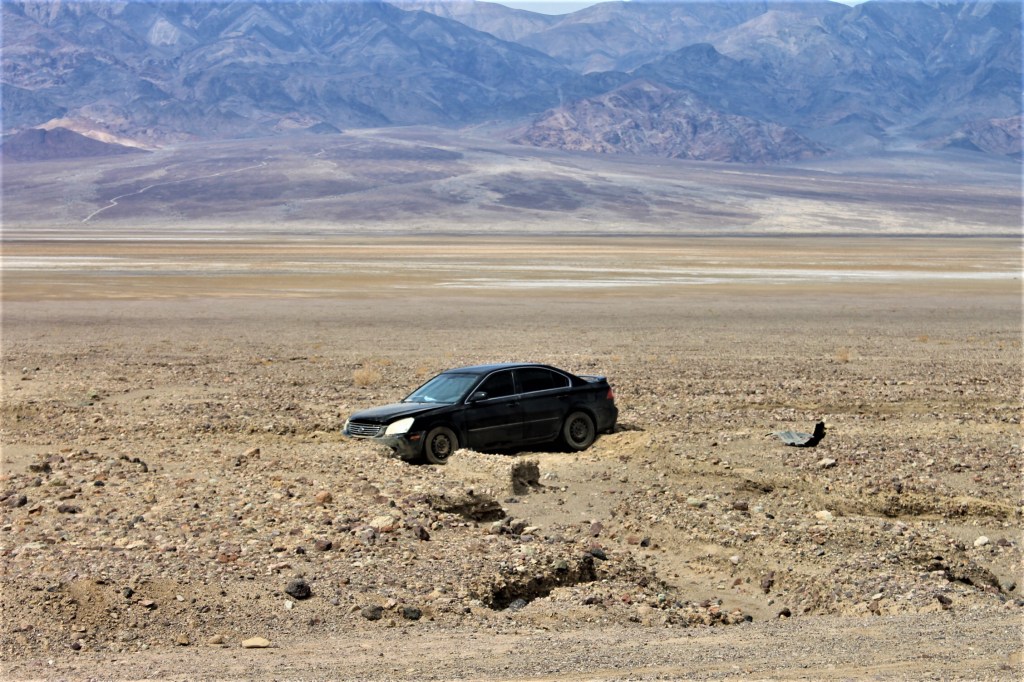
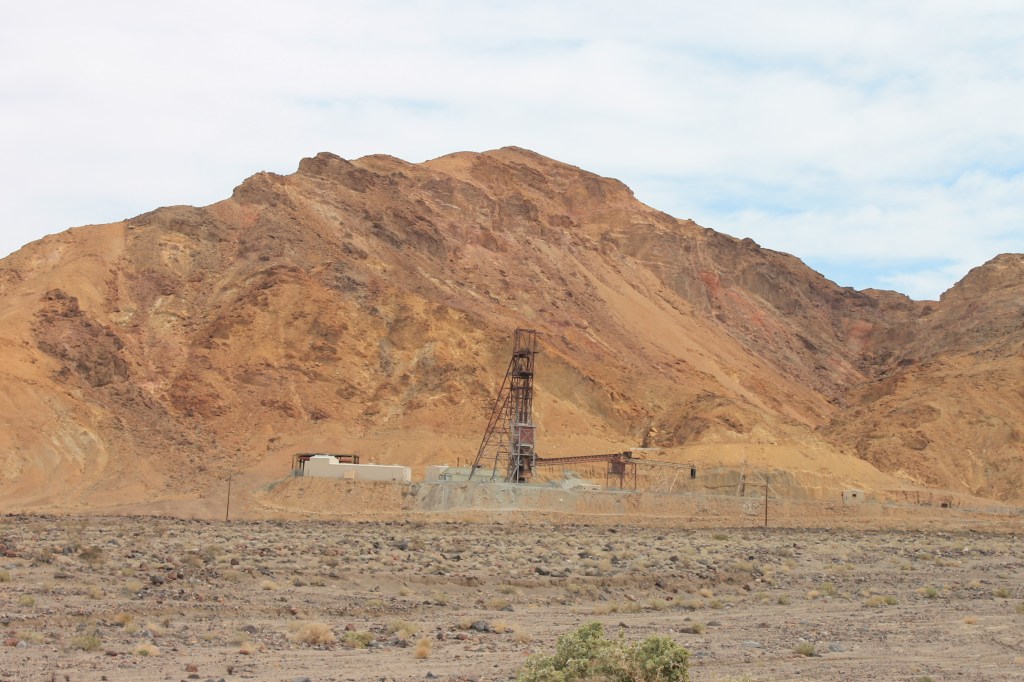
I just spent four days in Death Valley — one of the most desolate, isolated places in the continental United States. I take my camera on trips like this and take a lot of pictures of things.
Twice I stopped for pictures that had my wife questioning me. Both times I said the same thing. There’s a story there.
So, here’s your chance. Provide the story.
The first picture is of a car abandoned about 75-100 feet off the road in a place where I have absolutely no idea how it got there. I don’t recall seeing any tire tracks and the surface is pitted and bumpy enough I’m not sure how it could have got there. This is on the road from Furnace Creek to Badwater (the lowest piece of dry land on earth).
The second picture is of an old mine. I think it was probably a borax mine at one point. But I don’t think it’s operational anymore. You see things like this in places like Death Valley. Just random, in the middle-of-nowhere, factories or homes or buildings of one sort or other, that once thrived but now seem to be more ghost-like than real.
So … if you feel up to it and one of these (or both together) inspire a spark, write it and share it here. Put a link to it in comments if you post it to a blog, or email it to me and I’ll share it here. (mpaxson55@gmail.com)
In the meantime … hope you’re all writing. I’ve got more pictures to sort through.
Video Chat: Answering More Questions
—Berthold Gambrel
Below is the video of our latest chat, in which we answer questions from Priscilla Bettis and Anonymole. Thank you for the questions! We’ll be recording more chats to answer more questions soon.
Writing on the Edge
How close to the edge do you write? How far ahead in your story could you put into words and sentences, if you could type like Superman, before you’d have to stop and figure out what to do next?
Maybe we should think of a story in the process of being written as having two sections. The first section is the part of the story where you can – and must – find the concrete words and sentences to draw your ideas out and onto the glowing screen or the sheet of paper on your desk. The second section is further out. It’s the part of the story that you know you’re heading towards, but do not know enough yet to put it into concrete sentences.
How wide this first section is probably varies by the type of writer you are. Planners who have outlined, bullet pointed, and profiled their characters down to the minutiae could, if they were Superman, type the whole book without pausing. Pantsers, on the other hand, Superman or not, might only know enough about their story to speed type to the next paragraph, or the end of the chapter. I suppose most of us fall somewhere between these two extremes. I know I do – I do all my story outlining and choreographing of the scenes in my head, save for timelines which I put on paper to better keep track of those important details.
Anyway, while writing this week, I got to thinking about the concept of having scenes and dialog fixed so clearly in your head that you could hammer them out as fast as you can type. There were a number of days this week that I typed two to three thousand plus words in the course of four or five hours of writing. I could do this only because I had spent two months thinking about those scenes over and over again. My original plan was to hold off writing the story until I had the whole of it in my head like that, but I came to fear that, three or four months down the road, many of these early story details would have been forgotten by then. So I set them down now, and the words flowed. However, having done so, I now have to stop writing to dream up a similar set of details for what comes next. (I’ll edit what I’ve written while I do that dreaming.)
So, how do you write? How much do you know when you start writing, and how much is still vague or even unknown?
Video Chat: We Begin to Answer Your Questions
— Mark Paxson
Below is the video for our latest video chat, in which we begin to respond to the questions/suggested topics from our post at the beginning of the year. Thank you to those who offered suggestions. We really appreciate it.
The last question we address in this chat is a question related to the “rules” of marketing. I wanted to take a moment to provide a fuller answer than I did in the chat.
As I say in the video, I’m not sure what the “rules” of marketing are for writers. So, I struggle with that from the outset, but as I think about it more, I can come up with a few.
Establish a social media presence. I know of a writer who got a publishing contract with a small publisher. They published two of his books — cozy mysteries. But then passed on anything else from him because he didn’t have a sufficient social media presence for them.
This need for a social media presence is something that has been in the background ever since I started my publishing journey. You gotta have a blog! So, I got a blog. And then you have to have Twitter and Facebook and Instagram. And now, you better be on TikTok. Or the world is going to pass you by.
I’m on all of those things. Except TikTok. I just refuse to go there. But, social media has been both a blessing and a curse for me. The biggest problem is that I likely don’t use them the way I should to fully promote my written works. I don’t tweet regularly about my books. I tweet when there is something new to say about what I’m doing. Same with my blog.
Plus, my blog and my tweets are all over the place. They are not focused on my creative endeavors. I write and tweet about politics and food and photography and music and life in general. Which, to be honest, I think is a better way to develop an audience than the artificiality of never-ending marketing and promotion. I am who I am, both in real life and on social media. But the world doesn’t seem to work that way.
I’ve never established a huge following on social media. I’ve never approached viral status. And I’m okay with that. I’d rather develop a following naturally, through interaction with followers, than because of one single post or tweet that thousands see and decide to follow me … and then never interact with me again.
I gnash my teeth at times over the limits of what social media has offered me. But … here is the blessing social media has provided. Without it, my readership would be even smaller than it is now. Through social media, I have met and befriended so many other writers and readers and many of them buy my books when I publish something new. More than anybody else in my life, they are the ones who feed me and encourage me and support me in these endeavors.
Overall, at least for me, as frustrating as social media can be, I’d consider establishing a social media presence to be an overall positive. But I encourage you to make your presence what you want it to be. Be you and let your following grow organically. I think it’s far more rewarding than to develop a following that you never interact with. This, of course, gets to what your objectives may be — maximize sales or establish connections.
I’m not sure what other rules there are to publishing. We could discuss the querying process, the publishing process, and various promotional ideas. One of the things I’ve discovered with my last novel is that the on-line promo sites simply aren’t as effective and beneficial as they where when I started this journey ten years ago. It’s a fundamental reality of this business that there are ever more writers publishing ever more books, which makes it ever harder for writers to get noticed and to get readers to purchase their books.
One of the things I see is that you need to have a newsletter and an email list. And I just think … why? This is the type of thing that would just end up sitting in my email in-box, never being read, drowned by all of the other emails I get. 99% of which are spam and junk. I just don’t see how newsletters help. Somebody who has one and who has found success with it, please share that experience in the comments.
Whatever the rules of publishing were ten years ago, they’ve changed now because of how swamped the marketplace is. In some respects, I think the rules of marketing now are … do what you can. Try to find some niches where you can find readers and pursue them. But don’t expect much, because you are just one small fish in a very large sea. Set your objectives and dreams accordingly. Unless, of course, you are one of those rare writers who actually enjoys the promotion side of things. And good luck!
The Path to Fame and Fortune
We have been known to offer unsolicited advice on this site. In this case, it’s advice on writing fiction for fame and fortune.
Don’t.
Yah, I realize that you’re not going to take this advice. Didn’t expect you to. I mention it only so that you don’t blame me if fame and fortune eludes you. The credit if you do make money writing fiction is entirely yours.
Still, there are thousands of authors making a significant amount of money from writing fiction, so it’s not an impossible dream. The thing is that there are tens of thousands who aren’t, not to mention thousands who are spending a significant amount of money in indie publishing chasing that dream and not making the money back. The odds of finding fame and fortune in writing fiction have never been good, and they’re no better today, no matter what path you take.
There may’ve been a time, early in the ebook revolution, when a writer had a better chance of making significant money in indie publishing than in traditional publishing, but those days are long gone. Self publishing has its own gatekeepers now – Amazon’s algorithms that reward the best sellers with visibility, and the best selling authors who protect their turf by spending thousands, if not tens of thousands of dollars, promoting their books to potential readers on Amazon and Facebook. You have to be able and willing to pay to play in indie publishing these days for even the chance to make money writing.
The long and short of writing is that you have two equally daunting paths to fame and fortune. This suggests that the path you choose might be best chosen by determining the type of writer you are. Are you a novelist, or a pulpster?
Indie publishing is the pulp market of the 21st century. To be financially successful in indie publishing, you need to be a pulp writer. You need to be a very prolific writer, someone with more story ideas than you’ve time to write them down. And you need to be able to turn those story ideas into stories at 2,000 words, or more, a day, in order to produce three or more novels a year. You will also need to be an entrepreneur. You’ll need to spend money to hire cover artists and editors before your book ever has a chance to earn any of it back. You’ll need to learn the arcane art of efficiently promoting your books and be willing to spend folding money to do so. If you’re good enough, you can find fortune in indie publishing, though probably not fame.
If you’re not a pulp writer and/or an entrepreneur, if you need a year or more to write a novel, then you might be wise to pursue a career in traditional publishing – along with ten thousand other aspiring authors. Traditional publishing has its own arcane knowledge that you’ll need to master – how to do an elevator pitch, write a query letter, and compose a concise synopsis. You need to research agents, and maybe enter pitch contests and the like. Plus, it may well take several novels, hundreds of rejections or no replies, and a decade or more of your life in querying hell to sell a novel, if you’re lucky. On the upside, you don’t have to spend money on postage these days to send out your letters and manuscripts, though you can spend money on coaches and seminars, if you choose to. Both fame and fortune await your success. And there’s always indie publishing if all else fails.
Writing fiction has never been a smart way of making money, though that hasn’t stopped writers from trying their hand at it. And it probably won’t stop you either. But I believe that odds of financial success are pretty even between traditional and indie publishing these days, so that you can confidently pursue the publishing path you’re most comfortable with without looking back over your shoulder at the path not taken.
Tackling One of Your Questions
— Mark Paxson
At the beginning of the year, Audrey posted an invitation for you to suggest issues or questions for us to address. A lot of what that produced will be covered in future video chats, but I wanted to take a stab at one of them.
Anonymole ask the following questions:
• What’s your thoughts on writers writing only what they feel compelled to write, ignoring the market or even the concepts of demand? In other words, how much do you think writers should pay attention to their niche, if they even have one?
My answer to each of these questions will begin with the same thing. It depends. Unfortunately, that’s kind of a reality for me and it goes back to something we’ve covered a number of times in our video chats.
It depends on what your objective is.
Personally, I write stories I want to write, without regard to what the market is doing, or what readers are screaming for. At the same time, I write stories that I hope can find an audience. I have no interest in wallowing in my own internal craziness, producing something that would only mean something to me. So, I write stories I want to write with the hope readers will want to read them. 😉
But … if you’re writing because you want to get a publishing contract and get your name on the best-seller lists, then just writing what you want likely isn’t going to get there. You have to bend your art to what the market is looking for. And in the world of writing and publishing, that means what the gatekeepers (publishers and agents) think the market is looking for.
Who am I kidding? I want those things too — the contract and the best-seller. Unfortunately for those goals, I want even more to write the stories I want to write. Sometimes that means a story that might fit in with what the market is looking for, but if it does, it’s wholly incidental.
The story I’m working on, which will likely end up being about 40,000 words — too short to call a novel — could fit into the market. Although I may be a little late to this particular genre. Do you remember Gone Girl, how successful it was, and how it was followed by a number of other books with “girl” in the title? Well, my WIP is what I refer to as a domestic thriller that could very easily be titled … The Girl in the Basement. But, I want to resist that as much as I possibly can. We’ll see.
• Create a “known universe” (including an inviolate canon) or create a series — preference?
Again, it depends on your objective and the type of stories you want to write. The vast majority of what I write occurs in the known universe that we live in. Normal people dealing with situations of our modern existence. Occasionally, I dip into story types that allow for more creativity in what the universe is. I have a series of dystopian or post-apocalyptic stories that have been percolating for a few years.
But, I think the thing I don’t do is build worlds or develop new canons to occupy these stories. Instead, the stories are driven by the characters, who are all ultimately very human and like you and me, and what they’re going through to get through their lives. The world around them and its canons are not the story, they only provide the context in which the story occurs and I don’t do much with the world or its canons.
• Mundane world vs improbable world vs impossible world? Where do your stories take place? What do you think sells better or is more appealing as a burgeoning author? (i.e. The Notebook vs Hunger Games vs Harry Potter).
I think the examples in the parenthetical answer the question. Any and all of those can be successful. My stories all occur in the mundane world. I’ve struggled with efforts to write improbably or impossible fiction. Others who write on this blog have written stories that fit in those categories, however.
But … what sells? Who the hell knows. The gatekeepers decide that and what they look for are books that look like other books, with an occasional new idea popping up. Like Potter, which spawned hundreds or thousands of copycats. Like the Hunger Games, which spawned hundreds or thousands of copycats. But, have those two types of stories kind of run their course? Now, we’re on to something else aren’t we?
I think that’s the key, if your objective is to get published and grab an audience, it’s important to find the wave before it crests and ride it with your own take on what is popular. Or, best of all worlds, be the writer who writes something new that begins the wave — but it is much harder to sell that book to the gatekeepers.
Video Chat on Imposter Syndrome and Writing Environments
Looking Back
Have you ever gone back and reread your earliest published stories – not with the intention of revising them, but simply as a reader? If you have, I’d be curious to compare notes with you, since I’ve done just that. I enjoy rereading my favorite books, so rereading my own books wasn’t something unusual for me, though it did take a little courage.
If you did go back and reread them, what would you hope to find? On one hand, we’d like to find that our newest stories are better written than our earliest ones. That we have, indeed, learned something in the intervening years and tens of thousands of words we’ve written. But how much better? A lot? Or a little? If our newer stories seem too much better, what does that say about our first works? Would they be embarrassing? Of course, if we’re writing marvelous books these days, our early books could still be wonderful and we could still say that we’ve made significant progress. We’d have our cake and eat it too. But if our current work is not quite marvelous, how much “progress” would we be comfortable with, without being embarrassed to be found dead in a ditch with our first works? I suppose that the best case scenario is that we’d find that our first books are good and our most recent books are better. Kinda splitting the difference.
Well, as I mentioned at the start, I, with some trepidation, decided to go back and reread some of my early books. What I found, somewhat to my surprise, was that they were still good. Darn good, in fact, defying my expectations. Oh, I found a few typos, (imagine that!) and a few sentences that I’d like to rewrite, but on the whole, despite my efforts to write crisper, shorter sentences, these first books read remarkably well. Viewed one way, this result can be seen as rather alarming – suggesting little or no progress in a decade and several million words typed. But on reflection, I found several explanations for this phenomenon.
The first one is that my earliest self-published works are not my first written works. Prior to writing my self-published books, I’d written a fantasy novel, a SF novella, and a short story all of which I shopped around in the late 1970’s without success. After that, I’d spent a year planning another novel, wrote a YA novel, and puttered around on other stories for several decades. Thus, I already had my earliest works tucked away in the drawer, just like they say you should, before embarking on writing the books I eventually self-published.
Secondly, setting out to write seriously at age 60, after half a century of reading books, I feel that I had absorbed the art of storytelling, at least for the type of stories I wanted to write. I could write them more or less “by ear.” I knew what I wanted to write and wrote those stories, just as I’m doing now.
The third factor is that, as I’ve mentioned in other essays, I wrote these stories to my specifications, just to please myself. They’re custom-designed to please me, so it’s not surprising that I, at least, still find them very enjoyable.
The last, and perhaps the most telling factor, is that I am writing within the narrow limits of my talent. I write episodic novels. I don’t have amazing, mind-blowing science fiction concepts to explore. I have nothing profound to say about anything. And my range of narrators and characters is very limited. My characters are like old time movie actors, where you can still see the “movie star” in whatever character he or she plays in my stories. This is just as true of the stories I wrote ten years ago, as it is for my most recent stories. They haven’t changed significantly because they remain the type of stories I can write. My talent won’t take me any further. Nor, to be honest, have I any motivation to push beyond these stories, since I write what I like to read. Oh, I’d like to write them better – shorter sentences, fewer “and”(s) – that sort of stuff. But I have no ambition beyond that. I’m comfortable with my limits. I must have been standing behind the door when ambition was being handed out.
So while my exploration of my early works resulted in spending some enjoyable evenings rereading some of my favorite books, your experience may differ. You are likely more ambitious than me, and may’ve written increasingly challenging stories over the years. Or perhaps stories in different genres that might make going back to your earliest books more of a leap. Without a doubt, you were younger when you started writing and have matured along with your writing, which may also color your perception of your early work as well. And yet, skill in writing is not always the final arbitrator of enjoyment. Enthusiasm and originality may compensate for less polished prose. I would hope that when all is said and done, you too would find pleasure in your early works, should you decide to revisit them. And that with all the work and worry that went into them now years behind you, you can approach them simply as a reader and fully enjoy the worlds and characters that you, somehow, created.
In any event, I am certain we would all be curious to hear about your experiences in rereading your early work, or what you would expect to find if you did so.
 Writers Supporting Writers