Audiobook Follow Up Report
Last month I posted about Google’s offer to convert the ebooks published in their Play Store into audiobooks for free. Unlike most audio books that use human narrators, these books would be generated using Google’s AI technology to convert the text into the spoken word. Google suggested that it would best for non-fiction books, but I decided to convert my fiction books anyway, since I don’t think my style of writing demands a lot of dramatic reading. And it was likely the only way I could enter the popular audiobook market. It has now been a month; so how has this experiment fared?
I offer my ebook catalog of 11 titles for free, and since Google was offering to create my audiobooks for free, I was happy to offer my audiobooks for free as well. In May 2022, the first month of their availability, with 11 titles available, I sold 434 audiobooks, in addition to 293 ebooks.
Ebooks first. My peak sales of ebooks to date on Google was 836 copies in October 2021 and they have been declining since then – 643, 633, 459, 409, 303, 390, so that May’s 293 sales total is more or less in line with that gradual decline. The audiobooks didn’t seem to have affected ebook sales one way or another.
As for audiobooks, well, with 434 books sold in one month with no advertising – I only posted their availability on my seldom visited blog two weeks ago – I have to believe that I’ve tapped into a whole new market. Only one audiobook has a rating, and though it is a 5 star rating, the jury is still out on how the AI generated narration fares with audiobook listeners. However, from my own listening, I am optimistic that they are good enough now, and will only get better as time goes on, since Google said that they will update the files automatically as their technology improves.
My standard is “Good Enough,” which is to say that all things considered, something is indeed good enough, even if it may be a couple percentage points short of perfection. If you hold yourself to a higher standard, then perhaps Google’s AI generated audiobooks may not be up to your standard. That said, I have listened to samples of audiobooks with a voice actor who uses different voices for different characters, and found it annoying. It seems that my golden standard for audiobooks is my dad reading bedtime stories to us as kids. I do know that the AI does a better job of reading books than I did with my own kids. So I think my audiobooks are good enough.
To take advantage of this technology, you have to offer your ebooks on the Google Play Store, though of course, you can charge money for them, and for the audiobooks as well, if that is your policy. Selling books for free is a magnitude or two easier than selling them for money, so your results will vary.
Why?
— Mark Paxson
A sneak peek into our next video chat, which will be recorded this coming weekend …
One of the topics we’re going to discuss is “why do we read,” which I saw somebody ask on Twitter several months ago. Hell, it’s one of those questions I see people in the Twitter community ask at least once a week over on Twitter. But I thought it was an interesting question so I added it to our list for our conversations about writing.
Why?
Because, well, I guess if we don’t know why people read, how do we know what to write? And maybe even as important a question that grows out of that opening question of why we read is … why do we write?
So … in advance of our weekend chat, is there anybody out there who wants to share in the comments why they read? And for the writers out there, does that play at all into why or what they write?
Choosing Your POV
— Mark Paxson
I finished writing something and have pondered what to move on to next. This month started with me committed to writing a sequel to the novel I published almost a year ago. That particular story is told in first person from the perspective of several different characters.
The story I just completed is told in first person from one character’s perspective. About half way through, I decided to change it to third person and get some other character’s in the mix, to broaden the story a bit. But then I decided to keep in in first person because I wanted the story to be that character’s story and only hers. As a result, it makes for a much more minimalist of a story. We’ll see what people think.
Now I’m moving on to what’s next. I’ve decided to shelve the sequel above for another project. This morning I spent some time at a local books and music festival. I talked with a woman who has spent her life gathering historical tidbits of her ancestors and has spent the last five years putting those bits into stories. Kathy Lynne Marshall has written a handful of books in those five years. She includes information and resources about how to gather historical information about people from the past. So … I’m reading The Mystery of Margaret Booker now. About her great-great-great-great-great grandmother. Born a slave who walked to freedom 30 years later.
And an interesting thing happened when I got to the first page of the story. She tells it in first person. She is allowing Margaret to tell her own story in her voice.
That conversation and seeing the first person approach caused me to shift gears away from the sequel. I’m moving on to something that has been an objective for the last 4-5 years. A story about my grandmother, which I may have mentioned here a post or two ago. When I tried to launch the story back then, it was in third person. Which just seemed natural to me. How can I tell a story in first person from Grandma’s perspective? I can. Or at least I’m going to try.
More and more, it seems my stories are told in first person. My first novel wasn’t. Many of my short stories aren’t either. Most are told in third person, I believe. But lately, it seems like first person is the way to go. There is something about first person that I like. It’s easier to adopt a particular type of voice in first person. It’s easier to get inside a character’s head and see what they’re thinking and how they’re feeling.
But I wonder if that’s a good thing. Choosing a point of view or perspective because it makes the writing easier doesn’t necessarily make for a better story. Go back to that piece I just finishedd. I have no doubt that if I switched to third person and told the story from the perspective from multiple characters, the story would be more complex, with more layers. It’s what happened with my first novel — originally written in first person, but completely re-written in third person to allow for more details and more characters to have a place in the story. It definitely was a better story because of that change.
Occasionally, people ask how I decide POV for a story. I believe we’ve discussed it on video chats. My answer will always be … it depends. I still believe that, but I wonder what other writers think. How do you decide on the POV, or POVs, in which you’re going to tell a story? How do you decide between first person and third person? Is it a decision you can even describe? Because for me … it not only depends, it just kind of happens.
Create Audiobooks… For Free?
The audio book market continues to expand. I’ve read recently that while print and ebook sales rose 5% in 2021, audio books rose 18%. No doubt most self published authors have at least considered offering an audio version of their work. I must confess that I’ve never researched how to go about doing so, or how much it costs to create an audiobook, even though Smashwords offers links to audiobook narrators. Until now. Why now? Now, because the price has fallen to the point where I feel that I can afford it. Which is to say, I can convert my books to audiobooks for free.
Create audiobook versions of your ebooks for free? There must be a catch, you say. And you would be right. Several of them.
The first catch is that you have to publish your books on the Google Play Store. And the second is that this is a limited time beta program. I’ve had my books in the Google ebook store for a number of years now, and I was sent an email announcing this program. I don’t know how widely available it is, or whether or not if you put your books into the Google store now, if you would be eligible to take advantage of this beta version offer. The email implies that the program might not be a free service once it is out of beta. Still, it might be worth looking into, if you are comfortable with the big catch.
The biggest catch is, as you might suspect for the price, that the narration is being done by our AI overlords, not humans. So the question is, is it good enough? And that is one question that I am not equipped to answer, since I’ve listened only to a few parts of audio books – they are not my thing – so I’m not the person to judge whether or not the quality is acceptable or not.
Google suggests that it would be fine for non-fiction books without a lot of illustrations. But is it good enough for fiction? I think it might be, but not for the $20-$30 cost of a professionally produced audiobook. But as a low cost alternative… They might be acceptable.
You have your choice of 22 English speaking voices – 7 different American female voices, 5 American male voices, 1 female and 2 male Australian voices, 2 female and 2 male British voices, and 2 female and 3 male Indian voices of different age groups. Which gives you a good variety of narrators, though, of course, none of them are likely to match the narrator or character in your head. But that might be said for human narrators as well.
Here is a link to sample the various voices for English, as well as Spanish: https://support.google.com/books/partner/table/10957334?p=narrator_library
From the sample that I have listened to, the AI voice is aware of the context of what it is reading. And while it will not match the narration of a good voice actor, it is far from the robotic voices of some years ago. I have been expecting this – AI generated audio books – to happen for some time, and I am sure the process will only get better over time. So while the voice sounds quite human, the biggest downside I see – or rather hear – is that the AI narrates the story in a single voice. I believe that good narrators will narrate characters in different voices, so that you have a better sense of who is saying what. Without that change in voice, it can be sometimes hard to follow who is speaking. Though that will depend, in part, on how you use dialog tags and your writing style.
But when you consider the current price – and the fact that you can download the files and sell them on platforms other than Google – as long as you continue to sell them on Google – it seems like a pretty good deal. A deal that I found that I could not pass up, if only to see what type of sales and feedback I get with them. They can always be unpublished, should I find a strong negative reaction to them. Still, the way I see it is that these would, at the very least, be a way of getting my foot into the audio book door. And, since I can publish them at the cost of my ebooks – which is to say, free – I believe that my customers will get their money’s worth, no matter what.
If you are curious to hear how they sound, you can download one of my free books to sample by going to the Google App Store Book, Audio Books and search for C. Litka.
How Do You …
— Mark Paxson
… write creative non-fiction?
Anybody out there do this? I’d love your thoughts on how you approach stories that are based on real life and real people.
I write mostly fiction. Almost entirely fiction. I’ve written a few short pieces that were “grabbed from the headlines” so they have a basis in reality, but were at the end of the day fictional.
One morning, I got to work to learn that the body of a man had been discovered to the east of our building. I went home that night and wrote his obituary, without knowing a thing about him. Around the same time, I also wrote a short story about a man trying to survive in Aleppo, Syria, as his country was torn apart by civil war. Completely fictional, but I’d like to think there were some elements of truth in what I wrote.
I currently have a barely started short story that is similar to Aleppo in that is based on one man’s efforts to survive in Ukraine as his country is torn apart by a foreign invader. I haven’t got that far because I want to make sure it is different than Aleppo and I’m still pondering that.
That’s about it, I think. I blog a lot about things going on in my life, but they aren’t really “stories.” But … I have a couple of real-life-based stories I want to write and I struggle with the “how” of writing a real-life story.
The biggest one, the most important one, is a story I want to write about my maternal grandmother. I have an opening scene that is based on a lot of facts I remember about her, facts I’ve uncovered on-line (like the manifest for the ship she came to America on when she was 18), and things my mom has told me. But once I get past that scene, I have no idea how to approach the rest of the story.
One more example. I had an assistant in my day job for more than ten years. She lived a fascinating life in her younger years — involving guns and gangs and casinos and well, all sorts of stuff. She kept insisting that I should write her story. To which I kept responding, “I have no idea how to write a real story.”
Part of the problem is that I’m a pantser, not a plotter. Creative non-fiction, or a true biography, likely requires more plotting than pantsing. If it’s based on real-life events, the story is right there before you. As a pantser, that’s just not how I write and typically, when I have figured out the “rest of the story” is when my block settles in.
Another problem, particularly with my grandmother’s story is that there is a lot I don’t know. A lot. As a result, I’d have to make up quite a bit about her life and that scares me. I want it to be as true to her and who she was as it can be, but how can I be sure of that if I have to make up so much of it.
I know that the solution to this, at least with respect to my grandmother’s story, is to use the facts that I have where I can and then be comfortable with fictionalizing the rest, while trying to be as true as I can to her. But … I haven’t figured out how to get over that hump yet.
My question for you then, if there are any CNF, memoir, or biography writers out there, is how do you approach writing a story that is real-life, based on real-life, or loosely reality-based. I know there are classes and programs out there that promise to teach a person how to do this, but I’m not much of a classroom-learner. I just need some ideas, some methods, some concept of how to approach this and then I can go from there.
Video Chat: Answering Even More Questions
Pick-up Lines
People have a lot to say about pickup lines, which is to say, first lines, but the purpose is the same – to engage the interest of someone. In the case of a story’s first lines, it’s the reader. So what do they say? Here’s just a tiny sample:
“Beginning a novel starts with crafting its very first sentence, which should grab your reader’s attention and lead them right into your story.” – MasterClass https://www.masterclass.com/articles/how-to-write-a-great-first-line-for-your-novel
“Great first lines have that power, the power to entice your reader enough that it would be unthinkable to set the book down.” – The Write Practice https://thewritepractice.com/first-line/
“The first line of a story should create a sense of character, conflict, setting, mood, theme, or style — or any combination thereof. Most importantly, it should make the reader ask questions.” Diane Callahan How to Write a Good First Line https://medium.com/swlh/how-to-write-a-good-first-line-9bfef4399b9d
“No matter what genre you write, your first sentence is a seduction. It can be in the form of an invitation. A declaration. A tease. A promise. A jolt. A shock.
You must be shameless and your first sentence must be irresistible. It must induce curiosity and promise the answer to an urgent question.” Ruth Harris in Anne R Allen’s Blog https://annerallen.com/2018/04/how-to-write-a-great-first-sentence/
When the reader opens the book to that first line, it’s as if they’re opening up a line of credit with the author. But the tricky thing about that credit is that it has no substance right from the start. The reader could just give you one line and, if they don’t like it, they can close the book and move on to something else to read. Hence why writing a first line is so important.” The power of first lines in fiction by Josh Sippie https://www.writermag.com/improve-your-writing/fiction/the-power-of-first-lines-in-fiction/
And so it goes. Anyone who knows about writing will tell you just how important the first line of your story or novel is.
And many of them will offer you from seven to a dozen different ways to craft a first line. To pick some random ones: begin by stating your theme, or with a strange detail. You can establish your character’s voice, convey the stakes, or set the scene.
Bridge McNulty at Now Novel https://www.nownovel.com/blog/great-first-lines-of-novels/ sets out five types of novel openings: The Teaser, The Autobiographer, The Talker, The Announcer, and The Scene Setter. In short, there is a ton of advice on how to write your first lines that is readily available to every new and old author.
Now, take off your writer’s hat and put on your reader’s cap. How many books have you put down after reading the first line? How many first lines do you recall? I am rather curious because for me, after six decades of reading, I don’t think a first line ever meant anything to me. And I’m a ruthless reader – if a book doesn’t engage my interest in the first couple of pages, or chapters, I have no problem putting it down. I’ve got better things to do with my life than spend it reading a book I am not enjoying. But even so, I’ll give a book more than a line or two to engage me.
I suspect that the perceived importance of first lines in a story is a writer’s thing. A kind of a writer’s in-game to see who can come up with the most perfect first line. And I guess, I’m not immune from that game myself. I must admit that I do spend some time on my first lines – though I do not obsess over them. In fact, I put more time into crafting my closing lines, as I think they might be more important than the opening lines. They are the “landing” that you need to stick, if a book is to work. I often have them set along with my first lines before I start writing the story, serving as my target ending.
What got me to thinking about first lines was a blog post from Mark Lawrence where he listed the first lines from his novels and short stories. You can find that blog post here. I found a number that I thought were very clever (but I like clever writing.) I’ve posted my first lines on my blog from my published and from some of unpublished scraps here. Looking over my first lines, I find that they can be divided into three categories: boring scene setting ones, “The Scene Setter”, ones that open with dialog, “The Talker”, and the ones where I make some attempt at cleverness and foreshadowing, the “The Teaser.”
There are many memorable, pithy, clever, or shocking first lines in literature. So, as a bonus, here are several lists of famous first lines:
http://review.gawker.com/the-50-best-first-sentences-in-fiction-1665532271
https://www.boredpanda.com/famous-books-first-lines/?utm_source=google&utm_medium=organic&utm_campaign=organic https://www.considerable.com/entertainment/books/compelling-opening-lines-books/
So, how important are first lines to you, as both a writer, and as a reader? And as a writer, why not post some of your first lines in the comment section. Or post a link to your collection of first lines. As I suggested, it’s something of a game, dare to play?
A Writing Exercise
— Mark Paxson
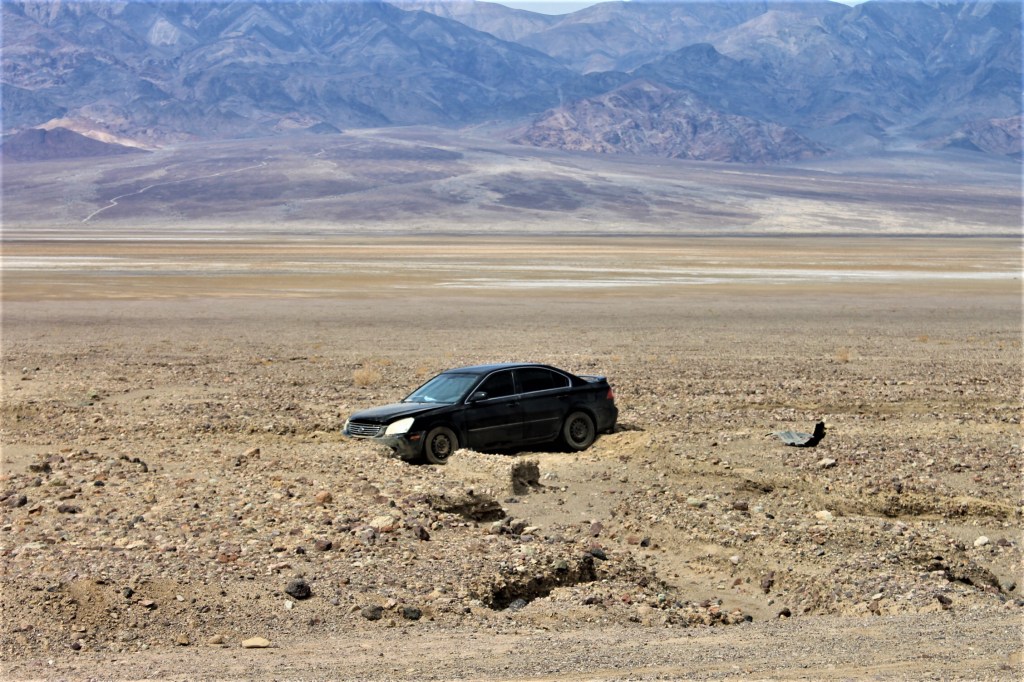
I just spent four days in Death Valley — one of the most desolate, isolated places in the continental United States. I take my camera on trips like this and take a lot of pictures of things.
Twice I stopped for pictures that had my wife questioning me. Both times I said the same thing. There’s a story there.
So, here’s your chance. Provide the story.
The first picture is of a car abandoned about 75-100 feet off the road in a place where I have absolutely no idea how it got there. I don’t recall seeing any tire tracks and the surface is pitted and bumpy enough I’m not sure how it could have got there. This is on the road from Furnace Creek to Badwater (the lowest piece of dry land on earth).
The second picture is of an old mine. I think it was probably a borax mine at one point. But I don’t think it’s operational anymore. You see things like this in places like Death Valley. Just random, in the middle-of-nowhere, factories or homes or buildings of one sort or other, that once thrived but now seem to be more ghost-like than real.
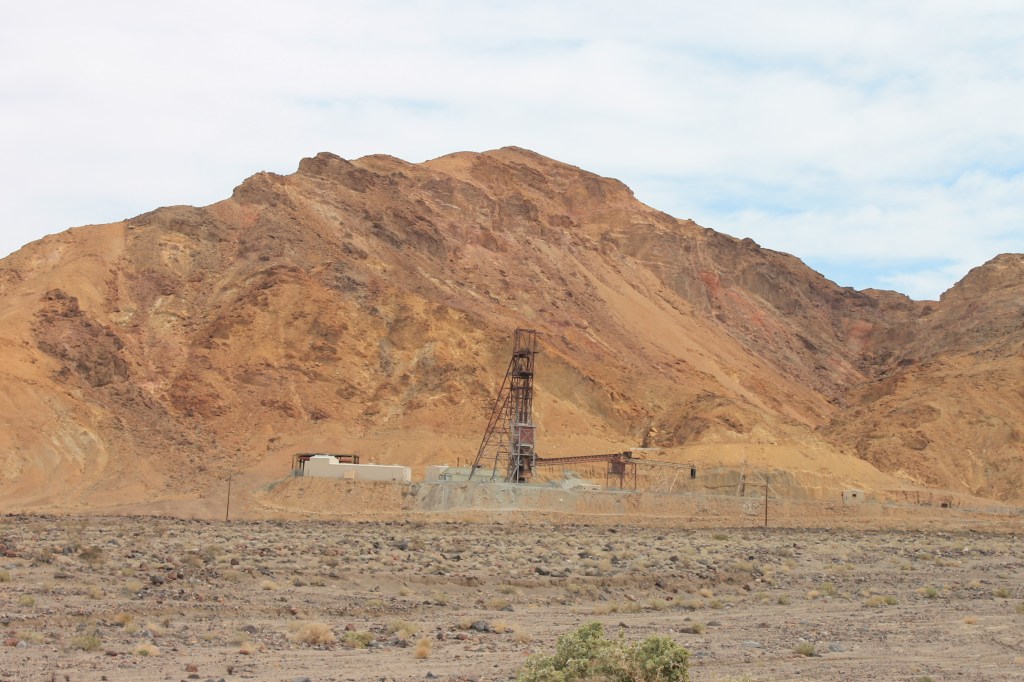
So … if you feel up to it and one of these (or both together) inspire a spark, write it and share it here. Put a link to it in comments if you post it to a blog, or email it to me and I’ll share it here. (mpaxson55@gmail.com)
In the meantime … hope you’re all writing. I’ve got more pictures to sort through.
Video Chat: Answering More Questions
—Berthold Gambrel
Below is the video of our latest chat, in which we answer questions from Priscilla Bettis and Anonymole. Thank you for the questions! We’ll be recording more chats to answer more questions soon.

